
Department of Sociology
As you know, just about all undergraduate courses will be offered remotely via the internet in the fall 2020 term.
The Schedule of Classes has been fully updated to indicate exactly how each class will be organized. Look up each of your courses in the Schedule of Classes to review the Course Format, the Section Comments, and the Course Notes.
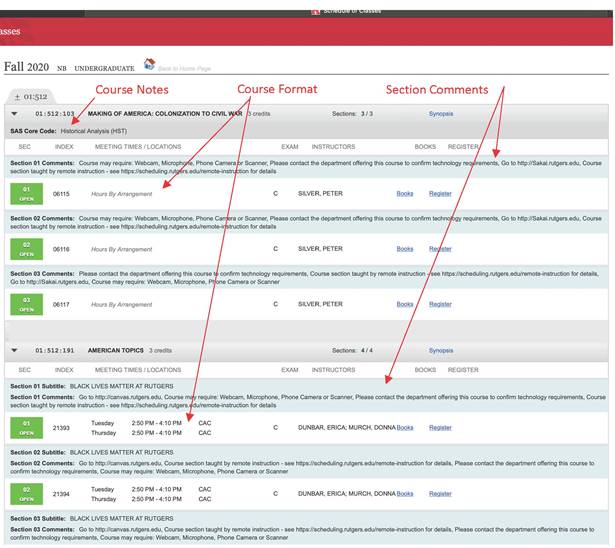
Course Format: In a WHITE box adjacent to each individual Index Number:
If the course format includes Days of the Week and Times, then the class meets live remotely, usually using Zoom or WebEx. You are required to be logged-in and in virtual attendance at those times. This format, sometimes referred to as SYNCHRONOUS REMOTE, emulates the face-to-face classroom experience and all students will be meeting together with the instructor at the designated times. You can ignore the Campus Location since the course is meeting remotely.
If the course format states Hours by Arrangement, then the class does not have specific meeting times, rather the course site will indicate specific weekly requirements and assignment due dates. In addition, flexible opportunities to meet with TAs, instructors, and classmates via Zoom or WebEx will be a part of these classes. This format, sometimes referred to as ASYNCHRONOUS REMOTE, provides flexibility for students who have difficulty being logged in at a particular time while we are operating in this remote environment including those that are now in other time zones. These courses still require the same number of hours per week as more traditional course formats and meet the same learning goals. These courses ARE NOT self-paced; there is a weekly schedule of assignments and work submission beginning the first week of classes and opportunities for live, remote, interaction.
If the course format includes both a specific meeting time AND Hours by Arrangement, then the course meets live remotely, usually using Zoom or WebEx, at the specified time. You are required to be logged in and in virtual attendance at those times. The courses ALSO contains more flexible weekly requirements that you will complete online. This format, sometimes referred to as HYBRID REMOTE, often allows recitations to meet live remotely as a group.
Section Notes: In a BLUE box located above each specific section of the course. The section comments include:
• How to access the course online using Canvas, Sakai or an alternative Learning Management System
• Topics Course Subtitles
• Prerequisite information
• Registration restrictions
• Software/technology requirements such as the need for a Webcam, Microphone, Scanner and/or Test-Taking Authentication Program. For resources, visit the Student Tech Guide and for financial assistance to acquire need technology, please contact the Office of Financial Aid.
Course Notes: In a GREY box located under the title of the course. The course notes include:
• SAS Core goals
• Instructions for seeking special permission
• Registration limitations and course equivalences
{slider Registration Policies and Deadlines}
Classes begin Tuesday, September 1. Please log in to Canvas and Sakai (or any other LMS listed in the Schedule of Classes for your courses) on Tuesday, September 1 to begin your classes.
WebReg and Registration Changes
Continuing Students may use WebReg now to make schedule adjustments. The add/drop period extends through September 14.
New, first-year students, will be receiving their schedules on August 20, and will be able to use WebReg to make adjustments beginning Tuesday, August 25, extending through September 14.
SAS Students may add and drop classes without a W through September 14, but must retain a full-time registration of at least 12 credits.
SAS Students may withdraw from individual classes with a W through November 30, as long as they retain 12 credits of active registration.
SAS Students may withdraw from all classes by taking a Leave of Absence through November 30.
{slider Class Attendance Changes}
TUESDAY, SEPTEMBER 8: attend MONDAY classes
WEDNESDAY, NOVEMBER 25: attend FRIDAY classes
{slider Advising and Registration Assistance}
Any scheduling changes, please contact the SAS Advisors.
Any questions related to your Sociology courses, please contact the Undergraduate department. We are happy to help!
{/sliders}
All of the courses you wish to have transferred from another institution outside of Rutgers—New Brunswick will have to be evaluated by the Sociology department, as well as the staff in the Transfer Center. This must be completed BEFORE you register for any courses that you wish to transfer. All courses eligible for transfer must have earned a grade of “C” or better. Any course earning below a “C” (2.00) will not be transferred.
In order to take a course outside of Rutgers and transfer those credits earned toward the Sociology major or minor, Criminology minor and/or Health and Society minor, you must first complete a Transfer Preapproval Form. Once the department approves your course, we will fill out our portion of the form. This form must be then submitted to the Academic Advisor before registering for any intended courses outside of Rutgers.
Limits on Transfer Credits
- Students majoring in Sociology must complete at least six courses (21 credits) at Rutgers-New Brunswick.
- The required 400-level course must be completed in New Brunswick and it is highly recommended that the required Research and Theory courses also be taken in New Brunswick.
About the Bachelor's Degree / Master of Public Health (BA/MPH OR BS/MPH) Articulated Degree
In partnership with Rutgers University–New Brunswick, the Rutgers School of Public Health offers highly-qualified undergraduate students the opportunity to begin graduate study during their undergraduate years, thereby accelerating the Master of Public Health degree by requiring approximately 3-5 additional semesters beyond the Bachelors degree. This is not a concurrent degree program. Students earn their Bachelors degree first and then the MPH.
{slider Program Contact}
Program Contact at the School of Arts and Sciences (for non-public health majors):
Adrian Bruning, PhD, MS
Assistant Dean
School of Arts and Sciences
Undergraduate Education-Academic Services
520 George Street, Room 103
New Brunswick, NJ, 08901
t. 848-932-8898
{slider Who is Eligible}
The Bachelors/Masters Program is open to all undergraduate majors attending Rutgers University–New Brunswick.
{slider When to Apply}
Interested undergraduates must be approved by their undergraduate school before applying. Once approved, they must apply to the School of Public Health between successful completion of 60 credits and before completion of 105 credits. (If you have taken more than 105 credits, please contact Mr. Kamal Kornegay, contact information is below.) Students will not be formally accepted into the BA/MPH or BS/MPH Program before they have completed 60 credits.
{slider Application Requirements}
Successful applicants must have demonstrated both a mature attitude and superior academic achievement. They must be recommended to the program by their major adviser or college dean.
Application requirements include:
- A recommended overall GPA of 3.2 at the time of application;
- A grade of B+ or better in a college level algebra course;
- Completed a School of Public Health Application for Bachelor's/Master’s Degree Program;
- One letter of recommendation from the Undergraduate Program Contact (listed above);
- One letter of recommendation from an undergraduate faculty member;
- Essay/statement of goals; and
- Official transcripts indicating all prior undergraduate course work.
- The GRE requirement is waived for students meeting the above admissions criteria.
Faculty or college dean letters of recommendation should include a brief description of the student’s interests, track record, and statement of maturity.
Click here to start the articulated BS-BA/MPH Application
{slider MPH Curriculum}
The MPH degree program requires 45 credit hours, comprising 18 credits of core courses, 15-18 credits of required concentration courses, 6-9 credits of electives, 3 credits of Practicum Capstone, an Applied Practice Experience (0 credits) and an Interprofessional Education Experience (0 credits). The Bachelors/Masters Program allows accepted BA/MPH or BS/MPH students to take up to 18 graduate credits of MPH courses at the Rutgers School of Public Health. These graduate credits MAY apply to both the undergraduate degree and the MPH degree, giving students advanced standing in the School of Public Health once students matriculate at the School of Public Health. Please note that the graduate credits earned as an undergraduate through the BA/MPH or BS/MPH degree program at the Rutgers School of Public Health cannot be transferred to other graduate programs. Visit the MPH degree webpage or each concentration's webpage for more information about the MPH curriculum. {/sliders}

Undergraduate Program

Graduate Program

Research


